
While movie stars like Akshay Kumar, Amitabh Bachchan and Salman Khan are among the top I-T payers, very few of the wealthiest Indians figure on the list.

India Inc on Thursday pitched for lowering income tax burden on common man, increase in capital expenditure, and firm steps to contain food inflation in their nearly two-hour long interaction with finance minister Nirmala Shitharaman ahead of the Union Budget. During pre-Budget consultation with Sitharaman, the industry leaders and associations also urged the government to focus more on infrastructure development with a view to maintaining the economic growth momentum. The industry leaders also laid stress on boosting the MSME (micro, small, and medium enterprises) sector, considered a backbone of the Indian economy and main employment generator.

An increase in the farmer income support scheme PM Kisan Nidhi, the introduction of a 'robot tax' to fund reskilling of people who lose their jobs to artificial intelligence (AI), and a reduced income-tax (I-T) to bring relief to the middle classes - these are some of the items in the Budget wish list submitted by Sangh Parivar affiliates to Finance Minister (FM) Nirmala Sitharaman. Representatives of the affiliates of the Rashtriya Swayamsevak Sangh (RSS), such as the farmer organisation Bharatiya Kisan Sangh (BKS); trade union Bharatiya Mazdoor Sangh (BMS); Laghu Udyog Bharati, which works for micro and small industries; and Swadeshi Jagran Manch (SJM), which works on economic and policy issues, met the FM and other officials over the last couple of weeks as part of the pre-Budget consultations.
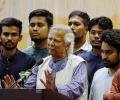
Muhammad Yunus urged the people to "exercise patience" before judging his government's role.

The rupee's plunging to record level and a sharp fall in the equity market are knee-jerk investor reactions to the US Federal Reserve's saying the it will slow down bond-buying programme in view of improving American economy.

Much of the rural recovery story is based on the premise of agriculture doing well. Even if it clocks a growth of 2.5-3 per cent this year, it is still just around 15 per cent of the overall GDP. The non-farm sector, which constitutes a bigger portion of the overall rural economy, is now hampered by disruptions and lockdowns.

'If we want real democracy, the economy itself will need to be democratised.'

The finance minister continues to be backed by the same policy team in charting out the broad strategy as in the few earlier Budgets.

Very high GDP growth which is driven by lots of concessions to large corporates.
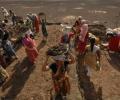
It has raised rural consumption, created new markets and shored up growth when investment falters.

The coaching-tuition-profiteering model built on the back of a broken education system is a scandal and an abomination, and must go, asserts Shekhar Gupta.

A host of conspiracy theories followed, involving Indira Gandhi, her younger son Sanjay, his favourite small car project, secret funding of the Bangladesh Mukti Bahini and even the Central Intelligence Agency of the United States.

India's manufacturing sector growth climbed to a 16-year high in March on the back of the strongest increase in output and new orders since October 2020, amid reports of buoyant demand conditions, a monthly survey said on Tuesday. The seasonally adjusted HSBC India Manufacturing Purchasing Managers' Index (PMI) surged to a 16-year high of 59.1 in March, from 56.9 in February, reflecting stronger growth of new orders, output and input stocks as well as renewed job creation. In Purchasing Managers' Index (PMI) parlance, a print above 50 means expansion while a score below 50 denotes contraction.

Of the eight RBI governors who have held office since the 1991 economic liberalisation, Bimal Jalan had the longest stint and S Venkitaramanan, the shortest. Current Governor Shaktikanta Das will overtake Bimal Jalan before completing his second term in December, points out Tamal Bandyopadhyay.

India will catch up with China by the year 2020 in terms of economic growth on the strength of its better efficiency of investments, an Asian Development Bank economist has said.

The lack of clarity on who is next in line, when the time comes, as indeed it will one day some day, reflects poorly on the management of the world's largest political party. It scarcely need be said that a squabble between the contenders, Shah and Yogi, is exactly what the doctor ordered for the Opposition, notes Krishna Prasad.
The ongoing financial sector crisis in the United States and its repercussions on developed markets worldwide will result in lower capital inflows into emerging markets like India, economists and government officials said on Thursday.

Should we not be creating roles in India for the talented, asks Ajit Balakrishnan.

It was for the second time in recent days that Modi has touched upon issues relating to diversity and pluralism, as he faces criticism over the issue of intolerance in the country.
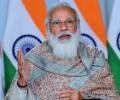
The Indian government today does not care what it does to Indians as long as it can continue on its path, observes Aakar Patel.

Adding petrol and diesel to GST was a challenging task due to their significant role as revenue generators for both the central and state governments.

The Indian economy will grow at around 6.5 per cent in the current fiscal, notwithstanding high crude oil prices and increased uncertainty due climate changes, NITI Aayog member Arvind Virmani said on Thursday. Virmani also asserted that the gross household savings ratio in India has consistently gone up. In an interview with PTI, he said: "My growth projection (of India's GDP growth) is 6.5 per cent plus minus 0.5 per cent... because my experience is that the fluctuations in global GDP more or less has balanced out for us, assuming normal changes."

'I have serious doubts about the longevity of the NDA government and the longevity of the 18th Lok Sabha itself.'

The study claims that from its peak of 18 per cent of gross domestic product in 2008, the crony capitalists' wealth is now down to three per cent

Gross non-performing assets of public sector banks surged to 9.32 per cent (Rs 4.76 lakh crore) of advances in 2015-16, from 5.43 per cent (Rs 2.67 lakh crore) in 2014-15.

Despite declining by three percentage points in 2022-23 (FY23) compared to FY19, Odisha's unemployment rate remains higher than the average in India.

On Friday, Biden announced his intent to appoint 14 people to the advisory committee, which provides overall policy advice to the United States trade representative on matters of development, implementation, and administration of the US trade policy.

The services sector growth in India rose to a six-month high in January as new business expanded at a faster pace amid buoyant demand from domestic and external clients, a monthly survey said on Monday. The seasonally adjusted HSBC India Services PMI Business Activity Index rose to 61.8 in January, up from 59 in December, pointing to the sharpest rate of expansion in six months.

About 56 million Indians may have plunged into extreme poverty in 2020 as a result of the pandemic, increasing the global tally by 71 million and making it the worst year for poverty reduction since World War II, according to fresh estimates by the World Bank. "The global goal of ending extreme poverty by 2030 is likely to be missed: By then, about 600 million people will remain in abject poverty. A major course correction is needed," Indermit Gill, chief economist at the World Bank, tweeted. The World Bank in its latest "Poverty and Shared Prosperity" made fresh estimates of poverty using a new extreme poverty line based on the purchasing power parity (PPP) of $2.15, the earlier one being at $1.9.
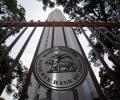
Rajan was expected to join the search committee to appoint three external members of a new six-member RBI Monetary Policy Committee

India's manufacturing sector growth climbed to a four-month high in January as a sharper upturn in new orders boosted output growth amid mild cost inflation, a monthly survey said on Thursday. The seasonally adjusted HSBC India Manufacturing Purchasing Managers' Index (PMI) recovered from an 18-month low of 54.9 in December to 56.5 in January. The latest reading highlighted the strongest improvement in the health of the sector since last September.
Crisil Ratings on Wednesday projected India's GDP growth at 6.8 per cent in the next fiscal and said the country will become an upper middle-income nation by 2031 with the economy doubling to $7 trillion. In its India Outlook report, Crisil said the Indian economy will take support from domestic structural reforms and cyclical levers and can retain -- perhaps even improve -- its growth prospects to become the third largest economy by 2031. "After a better-than-expected 7.6 per cent this fiscal, India's real GDP growth will likely moderate to 6.8 per cent in fiscal 2025," said the Crisil India Outlook report.

'Union Budgets are often used as political instruments and that was the intention of this government too.' 'But while the exercise has settled two fronts, it has left open several others and this has the potential to aggravate with time,' predicts Nilanjan Mukhopadhyay.

'If it is true that we are in a moment in time when the few economic advantages we hold are being lost, our focus must be on that rather than on finger-pointing,' says Aakar Patel.

A higher-than-expected consumer price inflation (CPI) print for March in the US has dashed hopes of an interest rate cut by the US Federal Reserve (US Fed) in June. Analysts now expect the US central bank to start cutting rates in September, provided inflation remains in check and oil prices remain supportive. The markets, analysts believe, partially factored in this possibility.

'Sweden removed the inheritance tax because many of the rich were fleeing. For example, the owner of IKEA had migrated out of Sweden'
Failure to address the core issue of development and overconfidence on the 'false campaign' of 'India Shining' led to the debacle of the Bharatiya Janata Party-led National Democratic Alliance in the elections, leading economists said on Thursday.
Two prominent economists and industry figures in India say the new government that would assume office next month should accord top priority to the agriculture sector.

Deloitte India on Friday said it estimates India's GDP growth at 6.6 per cent in the current fiscal helped by consumption expenditure, exports rebound and capital flows. In its India's economic outlook report, Deloitte said the rapid growth of the middle-income class has led to rising purchasing power and even created demand for premium luxury products and services. With the expectation that the number of middle-to-high-income segments will be one in two households by 2030/31, up from one in four currently, we believe this trend will likely become further amplified, driving overall private consumer expenditure growth, it said.

If the concerns over risking political capital are overcome, the long-term gains for the Indian economy will be immense, asserts A K Bhattacharya.
